
South Florida’s urban tree canopy is far more than aesthetic landscaping. It’s a critical infrastructure that delivers measurable environmental, economic, and health benefits to communities across Palm Beach and Broward Counties. As development pressure continues to reshape the region, understanding the science behind tree preservation has never been more important for property owners, developers, and municipal planners.
The Economic Case for Urban Trees
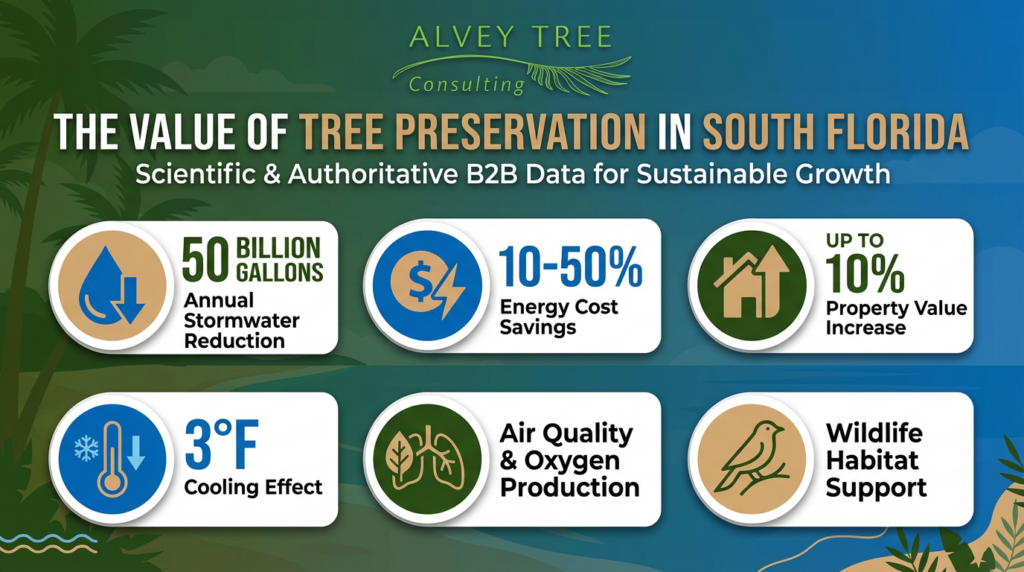
Research from the University of Florida demonstrates that Florida’s urban forests provide approximately $4 billion in annual benefits to the state. In South Florida specifically, trees reduce stormwater runoff by 50 billion gallons annually, saving municipalities millions in infrastructure costs and water treatment expenses (UF/IFAS Gardening Solutions).
Property values tell an equally compelling story. Studies conducted in Tampa, Florida found that houses with good tree cover sold for 6% more than comparable properties without mature trees. Other research indicates that tree canopy can contribute up to 10% of a home’s market value. For developers and property owners, this translates into tangible return on investment for every preserved specimen tree.
Energy savings provide immediate financial relief. According to peer-reviewed studies, shade from mature trees over buildings can reduce cooling electricity consumption by 10-50%, depending on coverage extent. One Florida study found that buildings in full sun required 2.6 times more electricity for cooling than buildings with full shade protection.
Climate Resilience and Heat Island Mitigation
Miami-Dade County’s goal to achieve 30% tree canopy coverage by 2030 isn’t arbitrary. Research shows that urban tree canopy can lower street-level surface temperatures by approximately 3.6°F through shade and evapotranspiration. In a region where extreme heat events are increasing, this cooling effect has life-saving implications.
Analysis of 308 studies demonstrated that air temperatures in urban forests averaged 3.0°F cooler than non-green urban areas. Tree canopy coverage has been directly correlated with decreased emergency calls during extreme heat events and reduced heat-related mortality. As South Florida faces longer, hotter summers, preserved urban forests serve as critical climate adaptation infrastructure.
Stormwater Management and Water Quality
South Florida’s flat topography and high water table make stormwater management a perpetual challenge. Trees function as natural infrastructure, intercepting rainfall with their canopies and allowing water to infiltrate through extensive root systems rather than overwhelming drainage systems.
Each mature tree can divert hundreds of gallons of rainfall annually into the ground, where pollutants are naturally filtered before reaching sensitive waterways like the Everglades, Biscayne Bay, and coastal estuaries. This ecosystem service reduces the burden on aging stormwater infrastructure while protecting water quality in communities from West Palm Beach to Fort Lauderdale.
Regulatory Framework in Palm Beach and Broward Counties
Both Palm Beach and Broward Counties have enacted tree preservation ordinances recognizing the critical value of urban canopy. Broward County’s Tree Preservation and Abuse Ordinance (Chapter 27, Article XIV) regulates tree removal, relocation, and protection during construction in unincorporated areas and several municipalities.
The ordinance requires:
- Permitting for tree removal or relocation except invasive trees which may qualify for exemptions
- Justified removal with mandatory tree relocation or replacement
- Construction protection measures including visible barriers and pre-construction meetings
- Mitigation requirements or payment into the Tree Preservation Trust Fund
Palm Beach County’s Unified Land Development Code (ULDC Article 14.C) establishes similar protections for native vegetation and specimen trees, requiring professional Arborist Reports for development projects affecting protected trees.
These regulations aren’t bureaucratic obstacles; they’re evidence-based policies protecting community assets with quantifiable economic value.
The Role of ISA Certified Arborists in Tree Preservation
Navigating tree preservation requirements requires specialized expertise. ISA Certified Arborists provide the technical assessments municipalities rely on to make informed decisions about which trees can be removed, relocated, or preserved during development.
Professional arborist services include:
- Tree inventories documenting species, size, condition, and preservation potential
- Arborist Reports specifying critical root zones and any needed monitoring during construction
- Expert coordination with landscape architects, engineers, and municipal officials
For developers and property owners, early consultation with a Certified Arborist can identify preservation opportunities that satisfy regulatory requirements while reducing project costs and timelines.
Best Practices for Urban Tree Preservation
Successful tree preservation during development requires proactive planning:
- Early assessment: Engage an ISA Certified Arborist during the planning phase, not after site plans are finalized
- Strategic site design: Orient buildings and infrastructure to preserve high-value specimen trees
- Root zone protection: Establish Tree Protection Zones (typically 0.5 -1.5 feet radius per inch of trunk diameter) with physical barriers
- Construction monitoring: Schedule arborist site visits during grading, utility installation, and other critical phases
- Post-construction care: Implement irrigation, mulching, and monitoring protocols for preserved trees under stress
Looking Forward: South Florida’s Urban Canopy
As South Florida continues growing, the choice between preservation and removal of urban trees has lasting consequences. Research consistently demonstrates that mature tree canopy delivers benefits no engineered system can replicate: natural cooling, stormwater filtration, air quality improvement, and property value enhancement.
For developers, landscape architects, and property managers, tree preservation isn’t simply regulatory compliance; it’s sound investment in infrastructure that appreciates in value, reduces operating costs, and contributes to community resilience in a changing climate.
Frequently Asked Questions
Q: Do I need a permit to remove trees in Palm Beach or Broward County?
A: Yes, in most cases. Broward County requires permitting for tree removal or relocation unless trees qualify for specific exemptions. Palm Beach County requirements vary by municipality, but generally require permits for protected species and trees above certain size thresholds. Contact an ISA Certified Arborist to determine requirements for your property.
Q: What are specimen trees and why do they matter?
A: Specimen trees are typically large, mature trees that provide exceptional ecological and aesthetic value. Both counties define specimen trees based on species and trunk diameter. Removing specimen trees usually requires higher mitigation ratios – sometimes 6-12 replacement trees per removed specimen.
Q: Can preserved trees increase my property value?
A: Yes. Research in Florida shows that properties with good tree cover sell for 6-10% more than comparable properties without mature trees. Buyers consistently pay premiums for established landscaping and tree canopy.
Q: What happens if construction damages preserved trees?
A: Damage to protected trees during construction can result in stop-work orders, additional mitigation requirements, and municipal penalties. Broward County’s ordinance specifically regulates tree protection during construction, requiring barriers, pre-construction meetings, and monitoring.
Q: How do I calculate tree mitigation requirements?
A: Mitigation calculations are complex, based on species, size, condition, and county-specific formulas. Standardized methods are used to determine how many replacement trees are required for approved removals. In some cases, payment into county tree preservation trust funds may substitute for on-site replacement.
Q: What is the Tree Preservation Trust Fund?
A: Broward County’s Tree Preservation Trust Fund accepts payments in lieu of on-site tree replacement requirements. These funds support tree planting projects throughout the county, enhancing overall canopy coverage in areas where it’s needed most.